

Cart
0
Much more than Aesthetic
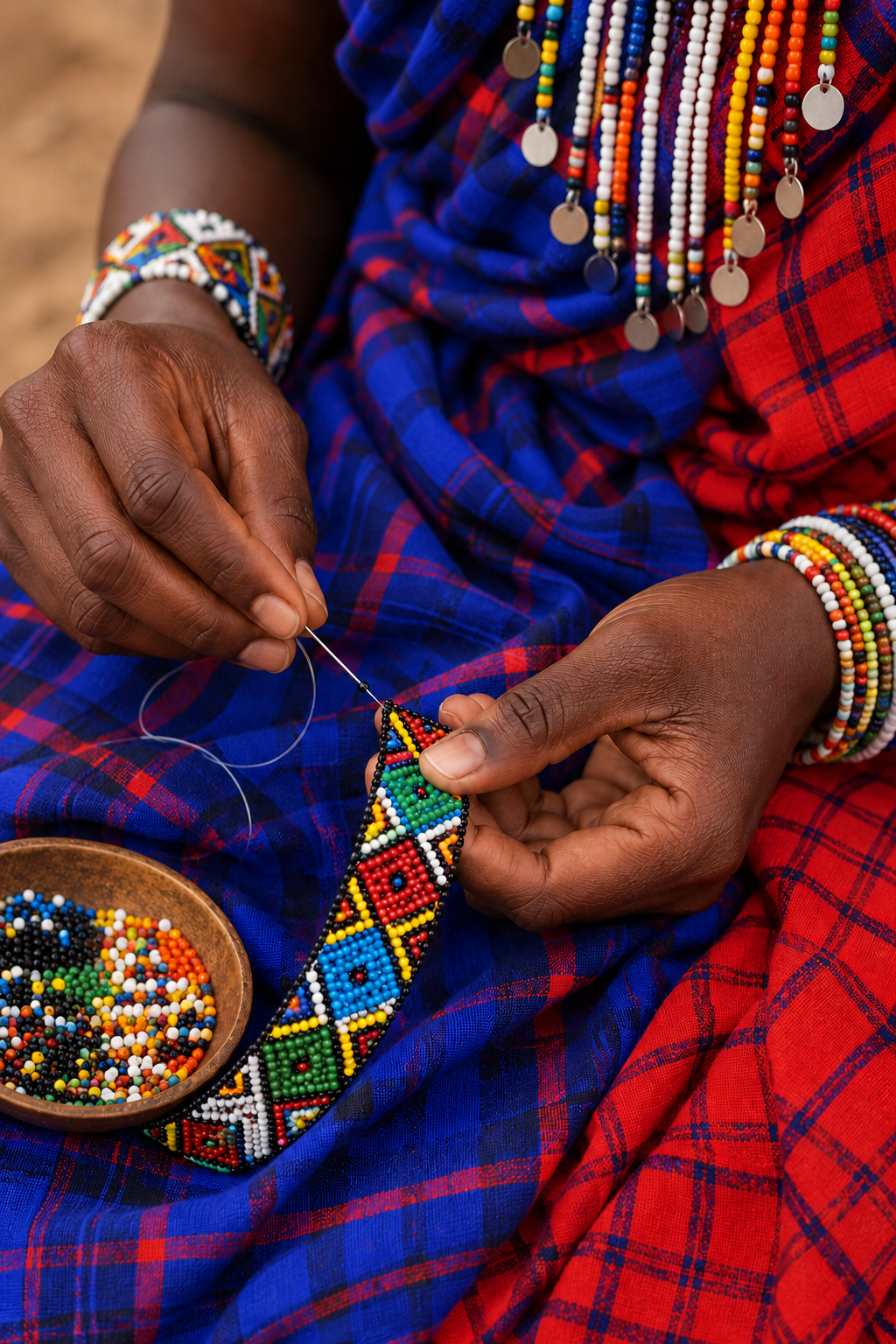
Beadwork holds a special place within Maasai culture. Color never goes unnoticed. Intense shades come together, repeat and form vibrant, iconic geometric patterns as the beads pass, one by one, through the hands of those who create them.
At first glance, it may seem like an explosion of color. But behind it lies a story.
In Maasai tradition, the colors used in beadwork have been associated with essential elements of life: cattle, land, water, food, hospitality, community, and the ability to face adversity. Their meanings do not form a rigid code, nor are they necessarily identical across all communities, but they are part of a cultural language passed down through generations.
Traditionally, it is women who create these pieces. It is patient, meticulous work, but also a shared activity. Women gather, work together, exchange ideas, and decide on combinations of colors and patterns as they make necklaces, bracelets, earrings, and other adornments.
Beyond their beauty, these pieces can communicate aspects related to identity, age, significant life events, or the status of the person wearing them. That is why looking at a Maasai piece purely from an aesthetic perspective means seeing only part of the story.
Red · Strength & Courage
It is probably the most recognizable color in the Maasai world.
In Maasai tradition, red is associated with courage, strength, and community unity. Its symbolism is closely linked to cattle and, more specifically, to the blood of cows, animals that for centuries have occupied a central place in Maasai economy, diet, and social organization.
It is also the color of many shukas, the fabrics we immediately associate with the Maasai when travelling through Kenya.
An intense color, visible from afar, that speaks of strength, but above all, of belonging.
Blue · Sky & Water
You only have to look up at the vast plains of Kenya to understand why blue holds a special meaning.
In Maasai tradition, blue is associated with the sky and water. The sky brings rain; rain nourishes the land, makes the grass grow, and provides water for both people and cattle.
From this connection to a resource essential to life also comes its association with energy and sustenance.
In a land where the seasons and rainfall profoundly shape the landscape, blue represents far more than the color of the sky.
It represents what allows life to continue.
Green · Land & Growth
After the rain, the savannah changes.
The dry earth begins to turn green and animals find food once again. This is why green is associated with fertile land, pastures, health, and growth.
Once again, the meaning of the color comes directly from the environment: from land capable of feeding the cattle and, through them, sustaining the community.
White · Purity & Well-Being
To understand white, we have to return to cattle.
Milk has historically been a fundamental food in Maasai pastoral life, and from this comes one of the most clearly documented color associations: white represents milk.
From that connection also emerge ideas of purity, health, peace, and well-being, all linked to nourishment and the ability to sustain life.
It is no coincidence that cattle appear once again. In Maasai color symbolism, nature, animals, and everyday life are constantly intertwined.
Yellow · Fertility & Energy
Yellow looks towards the sun.
In Maasai tradition, it is associated with growth, fertility, and energy. The sun allows the grass to grow; the grass feeds the cattle; and that cycle sustains life.
Other traditional interpretations also associate yellow with hospitality. This illustrates something important: meanings can vary and overlap depending on the community and the context in which the color appears.
There is no fixed dictionary of Maasai color. There is a living tradition.
Orange · Hospitality & Friendship
Perhaps one of the lesser-known meanings, and at the same time, one of the most beautiful.
Orange is traditionally associated with hospitality and generosity.
Its origin has been linked to the color of the gourds used to store and serve milk. Offering milk to someone who arrives is a gesture of welcome, and from this custom comes orange's association with receiving, sharing, and caring for a visitor.
It is also linked to warmth and friendship.
A color that speaks of something universal: opening your door and sharing what you have.
Black · Unity & Resilience
Black introduces a different dimension.
It can represent the Maasai people themselves and their unity, but also the difficulties and hardships that are part of life. This is why it is also associated with resilience and the ability to remain strong in the face of adversity.
It is not necessarily a negative color.
It speaks of hardship, yes, but also of the strength required to overcome it.
When Colors Come Together
A Maasai piece, however, rarely speaks through a single color.
Red alongside white. Blue alongside green. Black outlining a yellow, orange, or red geometric pattern.
This is where another language begins: the language of combinations and patterns.
Beads can express beauty and creativity, but they can also convey information related to identity, age, marriage, social status, or particular moments in life. Jewelry therefore functions simultaneously as adornment, artistic expression, and a cultural element.
That is why it would be too simplistic to say that each color has a single meaning and leave it at that.
Meanings change, blend, and evolve. They can differ between communities and even between the interpretations of individual artisans.
And perhaps that is where part of their richness lies.
A Language That Is Still Alive
Maasai beadwork does not belong only to the past.
It continues to be part of the lives and work of many women in Kenya and is also an important source of income for numerous artisans and their families. The tradition remains, but it also evolves: new designs emerge, new combinations appear, and pieces are created for people living thousands of miles from the lands where they were made.
And yet, something remains.
The hands.
The beads.
The colors.
And a way of telling stories without writing a single word.
Because when we look closely at a Maasai piece, red is no longer simply red. Blue is no longer simply blue. Green ceases to be merely an aesthetic choice.
Behind them are the land, the sky, the rain, the cattle, hospitality, strength, and community.
Color speaks too. You just have to know how to look.
Discover the colors of our Maasai jewelry.
