

Cart
0
The Infinite Land
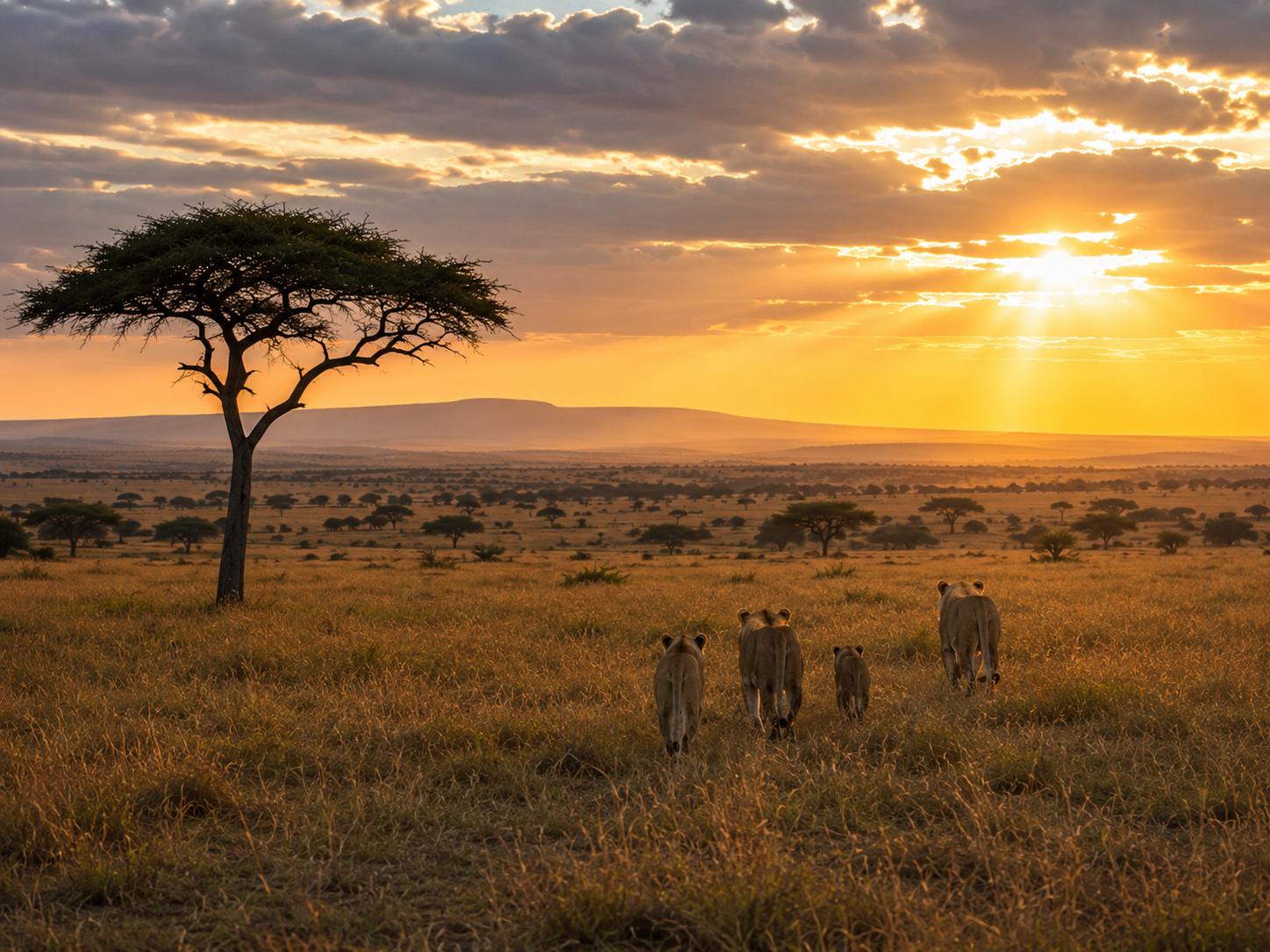
The plane descends towards a red-earth airstrip, and the Mara wastes no time in showing you where you are: like something from your best dream, you are greeted on landing by a pride of lions moving through the grass, oblivious to your arrival.
A zebra lifts its head for a moment, then goes back to grazing.
The earth has that unmistakable shade of rust and clay that, weeks after you have returned home, still somehow turns up in a corner of your suitcase. It is the first physical memory that takes you back. Before the images, before the names: that colour.
From the air, the savannah looks uniform. From the ground, it is something else entirely: the grass rises to different heights, the land rolls in gentle undulations, and around every bend something unexpected appears, a herd standing still, a solitary acacia, the glimmer of a river between the trees.
Early in the morning, the light comes in almost horizontally, golden and precise, turning whatever it touches, a rock, an animal, a tree, into something worthy of attention. At midday, the heat flattens the landscape and everything seems to come to a standstill. At sunset, the light returns with deeper colour and lasts only briefly, just a few minutes, before the sky changes completely.
It is a landscape that demands time. The stiller you are, the more you see.
Wild and Free
A herd of elephants crosses the track without breaking stride. Giraffes feed among the acacias while lions rest through the hottest hours of the day. In Masai Mara, the animals do not wait for you to arrive. They are there when you come, and they remain when you leave.
What is truly extraordinary is not simply the number of animals, but the way they appear before you: no stages, no schedules, no sense of watching a performance. Every encounter unfolds within a landscape that continues entirely on its own, regardless of your presence.
Sometimes it is a lion emerging from the grass. At other times, a line of elephants moving silently, a giraffe silhouetted against the horizon, or hundreds of antelope moving across the savannah at once.
And then comes something harder to explain: the overwhelming emotion of standing before so much beauty gathered in one place. There is a remarkable mixture of awe and peace, as though, for a few minutes, everything else simply ceases to matter. The landscape, the animals, the silence, the light. Everything seems to be exactly where it belongs.
It does not feel as though you are watching a scene arranged for you, but rather that, for a few moments, you have stepped into a world that was already unfolding long before you arrived.
When the Great Migration reaches the Mara, the scale changes completely. Vast concentrations of wildebeest and zebra arrive from the Serengeti, following the rains and fresh grazing, and some groups cross the Mara River. It is one of the great wildlife movements on the planet, and it happens every year, with or without you.
The Maasai People
The Mara is also, unmistakably, Maasai land. Maasai communities have lived in this region for centuries, long before today's parks and reserves existed, and their presence is not a cultural addition to the landscape: it is part of the history and the present of this land.
Their tradition is pastoral, and livestock, particularly cattle, occupies a central place in the lives of many families: a source of sustenance, wealth, identity and connection between generations. For centuries, the search for water and fresh grazing has shaped the movement of communities and their knowledge of the land. Today, this way of life coexists with education, technology and the changes of contemporary Kenya, without diminishing an extraordinarily strong cultural identity.
And then comes the colour. The shuka, the cloth traditionally wrapped around the body by the Maasai, is instantly recognisable for its checks or stripes and for a chromatic intensity that is impossible to ignore. Vivid reds, deep blues, greens, purples, oranges… colours that stand out against the ochres of the earth and the tones of the savannah, forming part of an extraordinarily powerful visual identity.
That same strength of colour appears in beadwork, an artisanal tradition practised largely by Maasai women. Necklaces, bracelets and ornaments are created bead by bead, combining technique, patience and knowledge passed down through generations. Designs and their meanings can vary between communities and contexts, but the precision and richness of colour are unmistakable.
And then there is the encounter: a smile, a warm and friendly greeting, a conversation, a few unhurried minutes shared together; a woman working with her beads, a herder beside his cattle. When these moments happen with respect and mutual curiosity, they too become part of what you remember about the Mara.
The Colours of Kenya
When you see a shuka in the Mara, that vivid red against the ochres of the savannah, that intense blue beneath the midday light, you begin to understand where an essential part of WEMASAI's visual universe comes from.
The Maasai fabrics that arrive in Spain are not reproductions of that aesthetic: they are authentic shukas, the same fabrics that form part of everyday life in Maasai communities. Their use, form and context may change, but the colour, texture and provenance remain.
The Masai Mara collection was born precisely from that connection. From looking at those contrasts, those fabrics and that richness of colour with admiration, and giving them a new place without erasing where they come from.
Masai Mara is not easy to leave behind. The red earth, the light at sunset, the movement of the animals, the colour of a shuka against the savannah. They are images that return on their own, long after you have come home.
Perhaps that is why some places do not end when you leave them. They stay with you forever, reappearing in a texture, a colour, a certain kind of light. And then, for an instant, you are there again.
