

Cart
0
THE LION, THE WARRIOR AND COURAGE
There was a time when facing a lion could make a young Maasai warrior a source of pride for his entire community. Today, that display of courage has found new forms of expression. Yet something remains unchanged: the power of their voices, the rhythm of their bodies, and a dance that continues to tell the story of a people.
Imagine the Kenyan savannah. A group of young warriors moves forward, spears in hand, following the tracks of one of the most feared and respected animals in their homeland: the lion.
For generations, lion hunting was part of the traditions of some Maasai communities. Known as olamayio, it was associated with courage, prestige and the identity of young warriors, the ilmurran.
It was not a test that every boy had to pass, nor did it necessarily involve facing the animal alone. Hunts were generally organised in groups and could lead to celebrations honouring the bravery of those involved.
For a traditionally pastoral people, large predators pose a genuine threat when they attack livestock, a vital source of livelihood and an essential part of community life.
Living alongside nature also means understanding its dangers.
And it is precisely this relationship with the natural world that lies at the heart of a fascinating cultural transformation.
FROM HUNTING LIONS TO PROTECTING THEM
As lion populations declined and conservation efforts grew, these practices began to change.
Hunting was banned in Kenya in 1977. But a legal prohibition alone cannot transform a deeply rooted tradition.
In 2008, something remarkable happened.
Maasai elders in the Amboseli region proposed an alternative that would allow young men to demonstrate their strength and courage without killing lions.
With the support of conservation organisations, the Maasai Olympics were born, first held in 2012.
Running races, spear throwing and vertical jumping offered new opportunities for young warriors to earn recognition.
The warrior could still demonstrate his abilities. The lion could continue to live.
A transformation initiated by the community itself, proving that preserving a culture does not mean preventing it from evolving.
And among these skills, we find one of the most recognisable movements in Maasai culture.
ADUMU: THE FAMOUS MAASAI JUMP
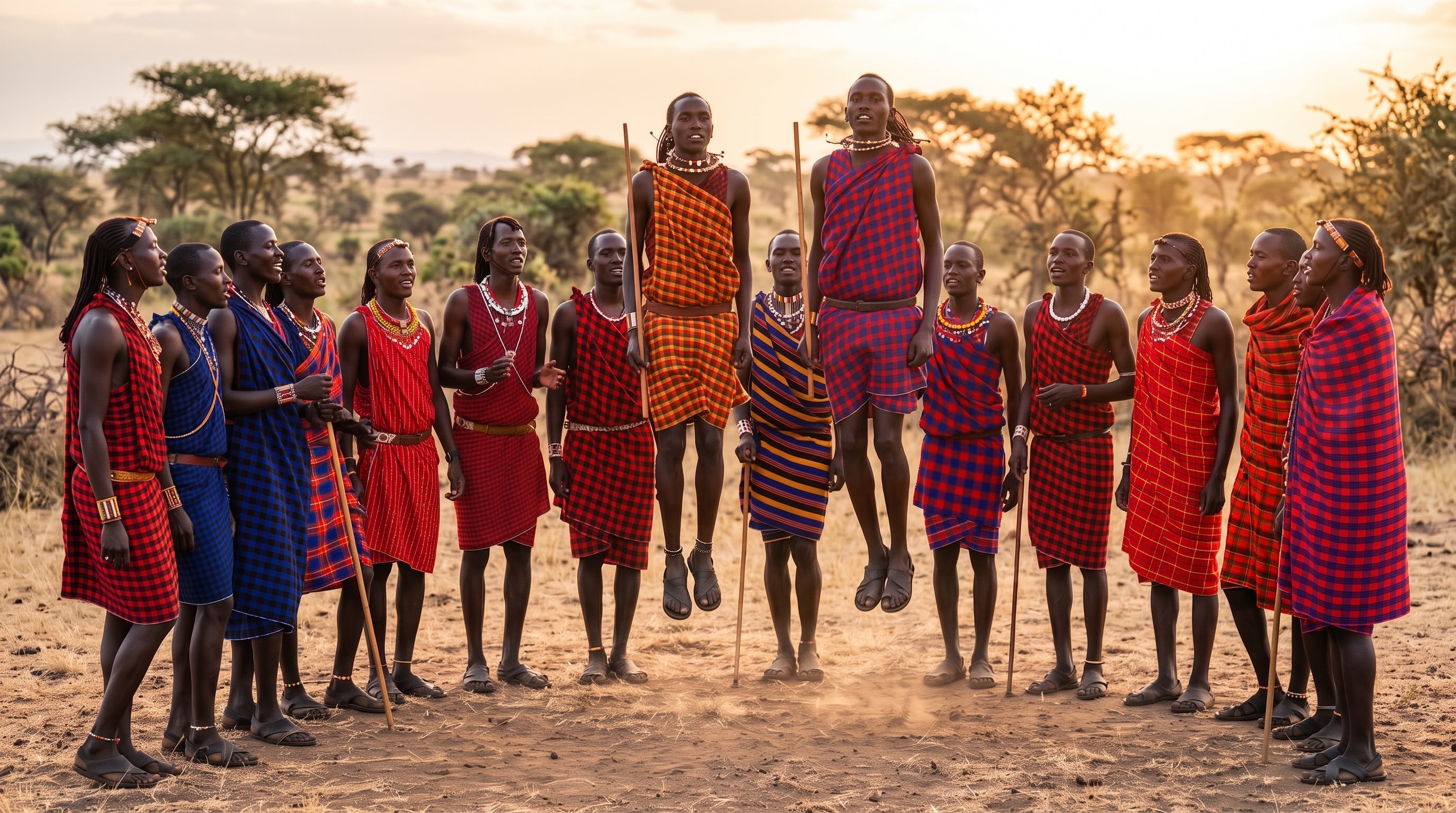
A group of young men forms a circle. Their voices begin to rise, and one of them steps into the centre.
Keeping his body upright, he leaps vertically into the air.
Then he returns to his place, and another takes his turn.
This is adumu, the celebrated Maasai jumping dance.
Its image has travelled around the world, but there is far more behind this movement than a display of physical strength.
The dance is associated with celebrations and community gatherings, including events marking different stages in a warrior’s life.
The height of the jump may inspire admiration, but rhythm, coordination and collective participation are equally essential.
Because the young man jumping is never truly alone.
His companions accompany him with their voices.
And that is where the real magic begins.
MUSIC BORN FROM THE BODY
Listening to traditional Maasai singing reveals a different way of experiencing music.
Deep voices create a powerful cadence. A soloist introduces variations, and the group responds. The rhythm grows, shifts and seems to envelop everyone taking part.
In many of these songs, the human voice is the principal instrument.
Breathing, repeated vocal sounds and bodily movements create an experience in which music and dance become inseparable.
You do not need to understand the Maa language to feel the intensity of this musical dialogue.
Voices meet, alternate and support one another.
And as the group sings, the bodies respond.
Perhaps this is why adumu is so mesmerising: we are not simply watching someone dance while others sing.
We are witnessing a group create music through their very presence.
WOMEN HAVE A VOICE TOO
The image of young warriors leaping into the air is probably the most widely recognised expression of Maasai culture.
Yet women also play an important role in its musical traditions.
Their songs accompany celebrations, gatherings and different moments in community life.
Choral melodies, voices answering one another and coordinated movements are all part of their performances.
In some dances, large circular beaded necklaces move with the body, adding an extraordinary visual dimension.
Music becomes a way of sharing emotions, expressing connections and passing on experiences.
Listening to Maasai women reveals another side of a tradition that deserves just as much attention as the famous jumps of the warriors.
Because no culture can truly be understood by listening to only half its voices.
CHILDREN AND THE MEMORY OF SONGS
And how does a child learn music that is woven into the everyday life of their community?
By listening.
By watching their elders. Repeating sounds. Gradually joining in the activities and celebrations they have known since childhood.
Songs help pass down knowledge, stories and ways of relating to others.
Music thus becomes a form of learning that goes beyond words.
Anyone who has heard a group of children singing knows that their voices carry an emotion that is difficult to describe.
It is worth remembering, however, that Kenya is home to many communities with distinct musical traditions. Not every children's song we associate with East Africa belongs to the Maasai repertoire.
Listening carefully also means taking an interest in where each voice comes from.
A LIVING TRADITION
Maasai culture is not frozen in an old photograph.
Its communities navigate social change, new opportunities and challenges involving land, livestock and wildlife conservation.
Their musical traditions are also finding new settings.
Jumping performances may form part of a community ceremony, a celebration or a cultural presentation for visitors. The meaning of each gathering depends on those taking part and the circumstances.
Yet the power of the voices remains one of the most moving expressions of Maasai culture.
Let us return to the savannah for a moment.
A young man steps into the centre. His companions sing. His body rises into the air and returns to the earth.
The rhythm never stops.
Because among the Maasai, music is not only heard. It is danced.
